Buck 110 Review – Does It Still Hold Up?


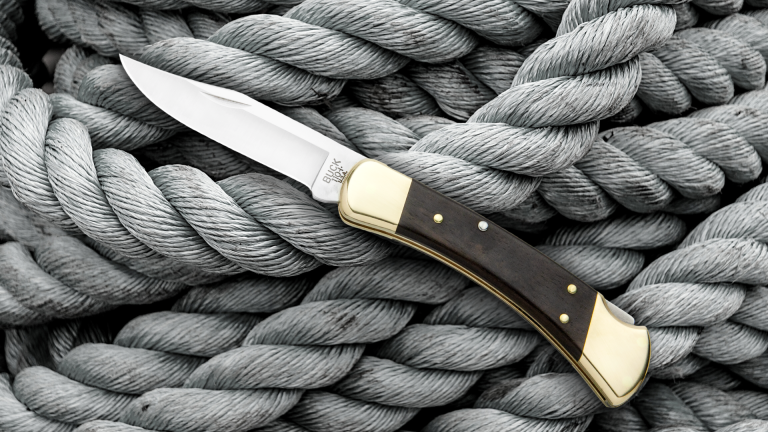
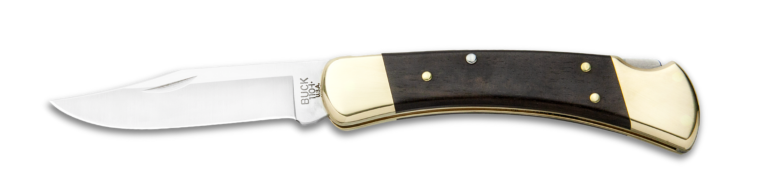
The Buck 110 Folding Hunter, one of the most iconic knives ever made, has officially turned 60 years old! It’s as popular today as ever, but a lot has happened since its release. Is the 110 still great, or has it been overshadowed by newer and more modern cutlery? I strapped a 110 to my belt to find out!
Knife Overview
Specs
- Price: $64.99
- Overall Length: 8.5"
- Blade Length: 3.75"
- Blade Material: 420
- Handle Material: Brass, Ebony
- Weight: 7.5 oz.
- Blade HQ Score: 70/100
Pros & Cons
Pros
- USA-made and backed by an excellent warranty
- Timeless design and heirloom-quality construction
- Sturdy lockback mechanism
- Available in a variety of handle and blade materials
- Premium leather sheath
Cons
- Very heavy compared to similar knives
- Difficult to open and close one-handed
Knife Character
Cool Factor – Score: 9/10
I feel like carrying a Buck 110 says a lot more about you than it does the knife. Every time I see a beat-to-heck leather sheath holding an equivalently loved Buck 110 on someone’s hip, I know for a fact they’ve got some stories. I think the brass bolsters and leather that show the age and scars of adventure out in the open for the world to see make the 110 one of the coolest knives in the business. But I will say that the coolness of the 110 must be earned through years of carry and use!
Origin Story – Score: 10/10
The Buck 110 was made by a father-son duo of Hoyt and Al Buck in the 1960’s. Its purpose was to provide strength more like a fixed blade on a folder. The knife was a smash hit, becoming by some estimates the best-selling knife ever made.
Its origin story isn’t what makes it special though. Rather, it’s the millions of adventures this knife has been on. It’s skinned just about every animal that walks around on Earth, been used on military missions that you read about in history books, had a role in who knows how many movies, and so much more. The Buck 110 is more than a knife; it’s an American icon.
Price & Quality
Affordability – Score: 9/10
When you think about the sheer amount of brass, exotic hardwood, and precision craftsmanship that goes into a Buck 110, it’s crazy that it only costs $65. Yes, there are cheaper competitors out there, but I’d argue none of them offers the same warranty and material quality as Buck. You’d be hard-pressed to find a similar knife that is both better and cheaper than the 110.
Fit & Finish – Score: 7/10
The 110 is nicely finished and is set permanently. No little parts to remove and lose. The action is just a tad crunchy out of the box, but with time and use it smooths out. The centering on my copy was just a hair off, but not enough to cause any problems. All in all, a well-made knife!
Ease of Operation – Score: 3/10
This is one of the places the 110 shows its age the most. It opens with a nail nick, and closes with a lockback lever all the way at the bottom of the knife. I’ve found a way to open it with one hand but it’s kind of awkward. You pinch the blade and flick your wrist to drop the handle, and with a solid brass and ebony handle, it’s really easy to drop. But closing the knife is a two-hand job. That’s usually not an issue, but sometimes when you’ve got your hands full you really notice it.
Buck is well aware of this, which is why they made the 110 Slim series. Those come with thumb studs for easy one-hand opening, although closing is still a two-hand affair.
Blade & Handle
Blade Steel – Score: 4/10
The base Buck 110 comes with a 420 stainless steel blade. There are a few upgraded steel versions, however all of them at least double the price of the knife. To Buck’s credit, each Buck 110 wields the Bos Heat Treat. The short story of that is Paul Bos, the world’s foremost expert on tool steel heat treatment, built Buck’s heat treatment facility and perfected the process for 420 steel. So when you get 420 steel from Buck, it’s the best 420 steel in the world. It’s a modest steel elevated by superior heat treatment, however today’s luxury powder steels will hold their edges longer.
But if you want a modern high-performance blade steel, the Bos Heat Treat gets tailored for those too. You might have to shop around the Buck brand, but many of the fancy steels are available on the 110. If you want the highest manifestation of any given blade steel, you’ll get it from Buck!
Blade Shape – Score: 8/10
The Buck 110 has a simple clip point blade. Its spine is robust enough for some hard work, and its hollow grind gives you a thin and slicey edge. It can do just about any job you give it. My only notes are that the blade is kind of narrow. This means that when you cut cardboard, apples, or other stiff stuff, the blade goes from thin to thick faster than you might like. But aside from splitting an apple more than cutting it, the 110 caused me no issues. A great blade indeed!
Handle Ergonomics – Score: 9/10
I’d bet this is one of the big reasons the Buck 110 was so popular when it came out. Its handle is darn near perfect. Big hands, small hands, forward or reverse grip, you name it. It’s super comfortable to use for whatever you’re doing. I knocked off only one point because it has no texturing, which can make it slippery when wet.
Handle Material – Score: 8/10
I’m really torn on this handle. I want to give it both a five, and a ten. Let me explain.
The pesimist inside me wants to give it a five. Brass isn’t as strong as some other metals, and it’s heavy. The Buck 110 tips the scales at almost half a pound. That is noticeably heavier than most folders I’ve ever used, and your arm really feels it after an hour or so in the hand.
But the optimist wants to give it a ten. First of all, brass is super classy. It feels old-school, and it wears in beautifully. The ebony inlays also look incredible. Buck Knives has a deal with Taylor Guitars, who has an ebony farm in Africa. Whatever wood isn’t up to snuff for guitars gets sent to Buck, who puts it on handles. The result is a cabinet-grade exotic hardwood in the handle, which has extreme cool factor. Ebony is also extremely resistant to changes in temperature and moisture, chipping, cracking, and warping (which is another reason it gets used in guitars). Sounds awesome, right?
So, in the name of compromise, I’ll give it a 7.5, which I’ll round up to 8 because I’m a nice guy. I will give Buck credit though, as the 110 and 112 Slim series has lightweight polymer and laminate handle scales for a more modern handle experience. Thanks Buck!
Carry – Score: 3/10
I’m sure I’ll catch some heat for this one, but the carry on the Buck 110 is the biggest reason I don’t carry mine more often. The knife comes with a very nice leather belt sheath, but that’s the only good way to carry it. If you try to carry it in a pocket, it sinks to the bottom where it becomes a brick in your pocket. But that sheath gives you many of the disadvantages of carrying a fixed blade! It’s hard to get to the knife when seated, it snags on things, and it really hurts if you fall over on it. Carrying a 110 feels more like carrying a fixed blade than a folder, which can be less convenient in day-to-day carry.
Once again, Buck gets it. That’s why the 110 and 112 Slim series have pocket clips.
Quick line about Buck, I really appreciate that they cater to so many people’s desires. Some people want the classic old-school Buck 110, and they make it. Some want something more modern, and they make it. Whatever you want, Buck makes it, and makes it really well!
Compare & Contrast
The knives I list below are similar in spec and style to the 110, and I think each of them is worth your consideration.
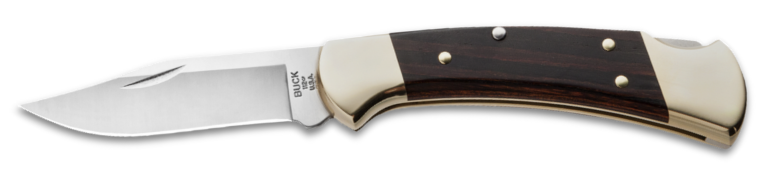
- Buck 112 Ranger – This is essentially a Buck 110 Mini. It’s a fair bit smaller and easier to carry. I generally prefer the 112 to the 110, but that’s just me.
- Buck 110/112 Auto – These take the iconic knives and turn them into automatics. That makes for extremely easy one-hand opening. In recent years, the autos have been just as popular as the manuals. That automatic action does bring the price up though.

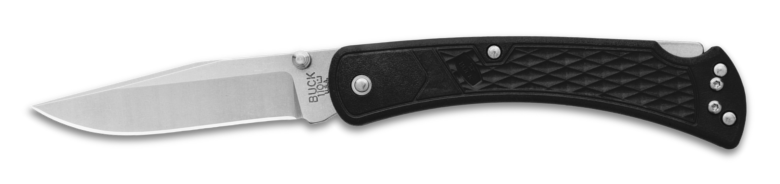
- Buck 110/112 Slim – I mentioned these a few times in the review. These have the same silhouette and design as the 110 and 112, but they’re much more modern in materials and mechanisms. Last time I checked, CJ Buck, who runs the company today, carries one of these in his pocket.
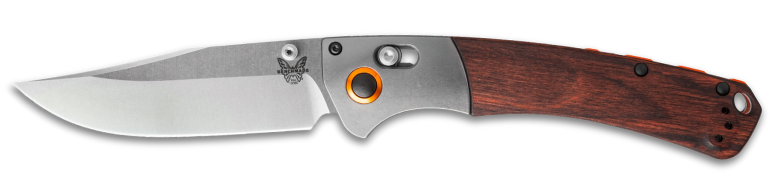
- Benchmade Crooked River/Mini Crooked River – Very much like the 110 in styling, but made with luxury materials and modern mechanisms, although it’s a fair bit more expensive.
- Cold Steel Ultimate Hunter – If you’re considering the 110 for hunting, this one offers better edge retention and a much lighter G-10 handle.
- Case Folding Hunter – If you the classy look of the 110, this one is even more old-school, with two blades and a slip joint mechanism.
Conclusion
The Buck 110 is a solid knife. If you chose it as your daily companion, you’d be following in the steps of greatness, and the knife would serve you well. Its classic design is part of its charm, and it remains popular to this day even as modern materials and mechanisms have proliferated. I own a 110 signed by CJ Buck, and it’s a prized piece of my collection. But when I choose my knife in the morning, I tend to gravitate to knives more pocketable and one-hand operable. The good news is that Buck makdes something for everyone, whether they like modern knives, classics like the 110, or anything else. Right now, I’ve got my eye on that Range coming later this year…


 Copyright © 2026 Blade HQ. All rights reserved