Knife Blade Coatings Explained – 6 Most Popular Types


In This Guide
- What Are Blade Coatings?
- Why Knives Have Blade Coatings
- Types of Blade Coatings
- Blade Coatings Comparison Table
- Do You Need a Blade Coating?
- FAQ
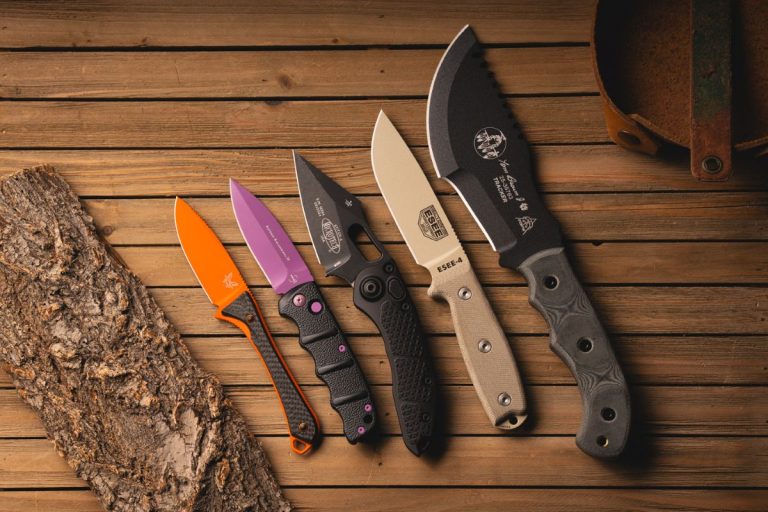
From DLC to Cerakote, knife blade coatings come in many forms, colors, and names.
In this guide, I’ll explain the most common blade coatings, what they do, and how to choose the right one for your needs.
What Are Blade Coatings?
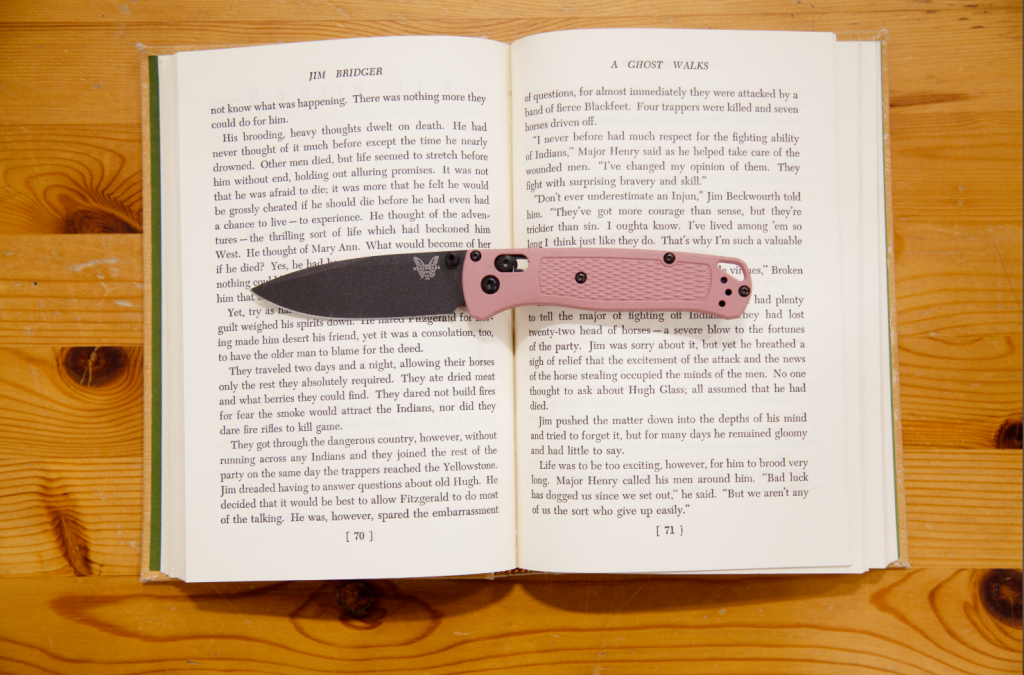
Blade coatings are a separate substance that has been applied to a blade.
There are various reasons you might want a blade coating, and many types of coatings. We’ll explore both in the following sections.
Notably, blade coatings and blade finishes aren’t the same thing.
Often, a blade coating can be referred to as a finish, but there are many blade finishes that aren’t coatings, including the following:
- Patina (the oxidation of the steel itself)
- Acid finishes (also oxidation)
- Black Oxide (still oxidation)
- Stonewashes (scratches in the steel)
- Polishes (just the raw steel)
Why Knives Have Blade Coatings
There are many reasons, including style, blade protection, and function. Let’s explore each:
Style
Sometimes you want a blade coating because it looks awesome!
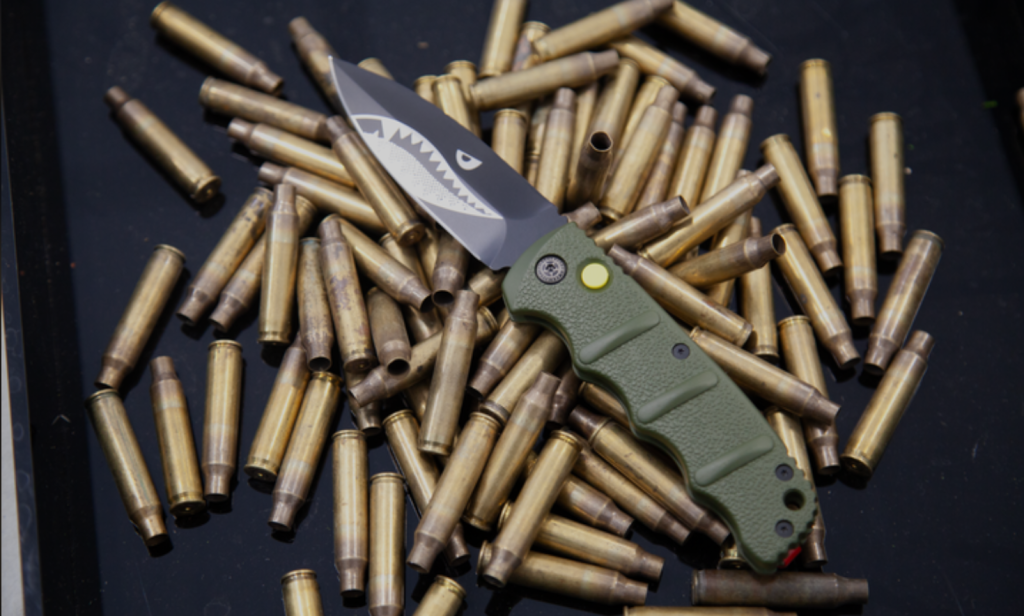
Most blade coatings are black for that tactical flare, but you can get colors like blue (as with this Pro-Tech’s Sapphire Blue or whole graphics (as with our Blade HQ Exclusive Kalashnikov).
Additionally, some people love the rugged look of a worn, banged-up blade coating.
Protection
Protection is especially important for non-stainless steels, as a blade coat can fend off rust.
One of my favorite steels for performance is CPM M4, but it’s susceptible to rust if it’s not oiled, kept dry, etc.
But with the right coating, it might as well be stainless.
Even knives with stainless steel blades benefit from the added protection of a coating.
Function
Functionally, coatings can have profound effects on knives.
Some coatings offer a lower coefficient of friction than raw steel, helping them make clean, effortless cuts and prevent whatever you’re cutting from sticking to the blade.
Not all coatings are safe for food, but some are, and they can be great for your kitchen cutlery.
Types of Blade Coatings
Not all coatings are created equally. Each is tuned to meet a specific set of characteristics, and where one coating excels, another underperforms.
It’s important to choose the right kind of blade coating—in fact, it’s almost as important as choosing the right type of steel! The wrong type of blade coating can cause your knife to underperform.
To help you maximize your knife’s performance, we’ll break down coatings in detail below and show off some popular knives that use them.
1. Paint
This is the simplest of all coatings: just a layer of paint sprayed onto the blade.
If you like the look of a worn blade finish, this is the one for you. It doesn’t take much to start the fade on a painted finish.
In no time at all, your knife will look like it’s been to war and back.
The only problem is that regular, hard use of the knife can reduce the coating to almost nothing.
But never fear! The same rattle-can paint jobs that look so good on firearms work just as well (if not better) on knives!
If your paint coating wears away, you can apply a new one! Just pick up a can of spray paint at your local hardware store and make your knife look brand new again.
Perhaps the most popular knife with a paint finish is the Boker Kalashnikov. Both the handle and blade are painted, and they come in any color you like, even a fancy donut version!
Pros:
- Affordable
- Easy to apply at home
- Available in any color
- Can be made into patterns
Cons:
- Some paints are toxic
- Chips and flakes off when it wears
Does it wear?
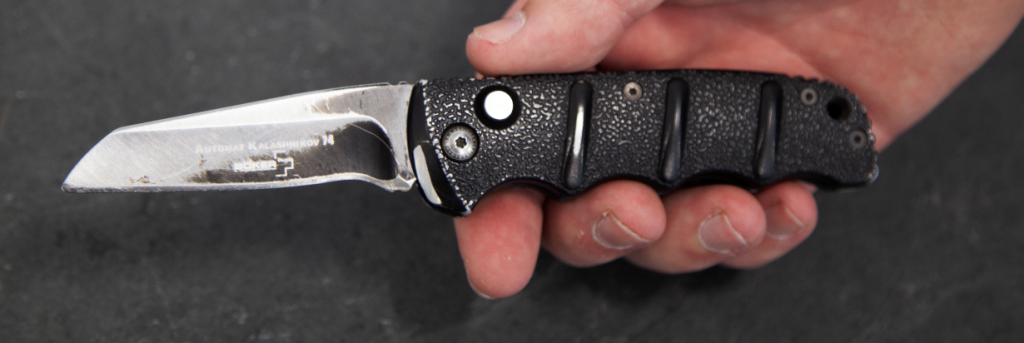
Yes. Just look at my buddy Timote’s beat-to-death Kalashnikov. Awesome!
2. Powder Coat
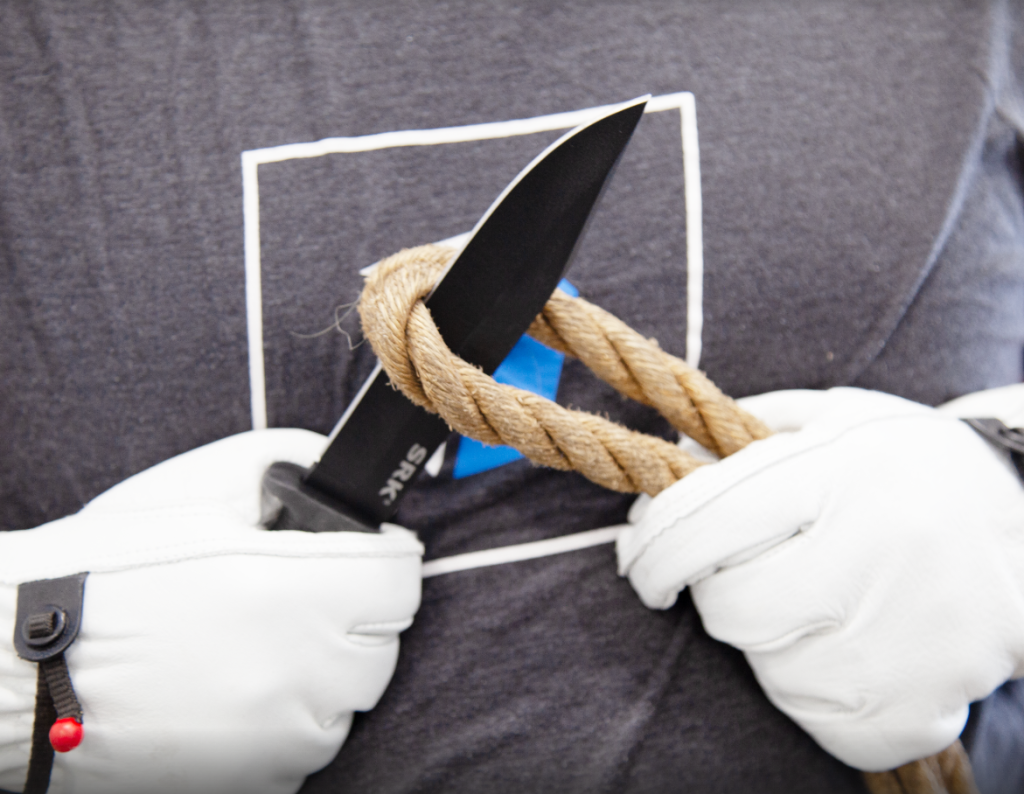
Powder coats are a mixture of powdered epoxy, dry pigments, and solidifying agents applied to a blade via a spray gun or fluidized bed and cured in an oven.
It’s cheap, available in tons of colors, and rugged enough for hard-working applications.
This coating was designed for machinery, but since its introduction, it’s found its way onto everything from kitchenware to carnival rides.
It’s everywhere: there’s probably a powder coat application business near you.
Go ahead, look it up! I found out I pass six of them on my 15-minute drive to work, and I can see one from where I sit at my desk writing this article.
Although powder coats are applied professionally, it’s not too hard to do it yourself. If you’ve got an oven, an air compressor, and a Benjamin burning a hole in your pocket, you can have the entire apparatus to apply powder coats at home.
Powder coats are very strong, resist impact, and wear quite well. Long, hard use will eventually make them fade.
The surface of the coating is rougher than steel, though, so cutting stuff often leaves tracks that don’t wash out easily.
You see powder coats on a lot of fixed blades, especially from TOPS and ESEE knives. The coating does wear, but it takes a lot of time, use, and patience to earn them.
In survival and bushcraft circles, the wear on your knife serves as a litmus test.
Pros:
- Affordable
- Can be applied at home
- Durable
- Prevents rust
- Available in many colors, even clear
- Most are food-safe
- Non-reflective
- Can be made into patterns
Cons:
- Rough surface can hinder cutting performance.
- Difficult to fully clean
- Some chemicals can strip it.
Does it wear?
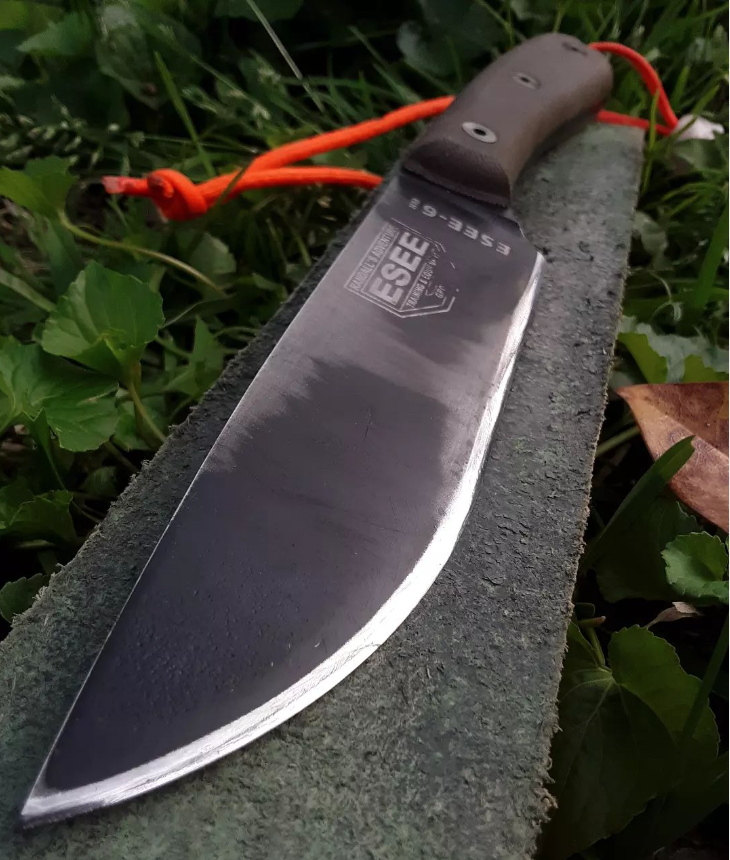
Yes, with time. Bushcraft Kelso, a wilderness survival trainer, carries a different knife for an entire month and uses it for all his bushcrafty shenanigans. Check out the sweet fade he earned for his ESEE 6HM in April 2023!
3. Vapor Deposition (TiN/PVD/DLC)
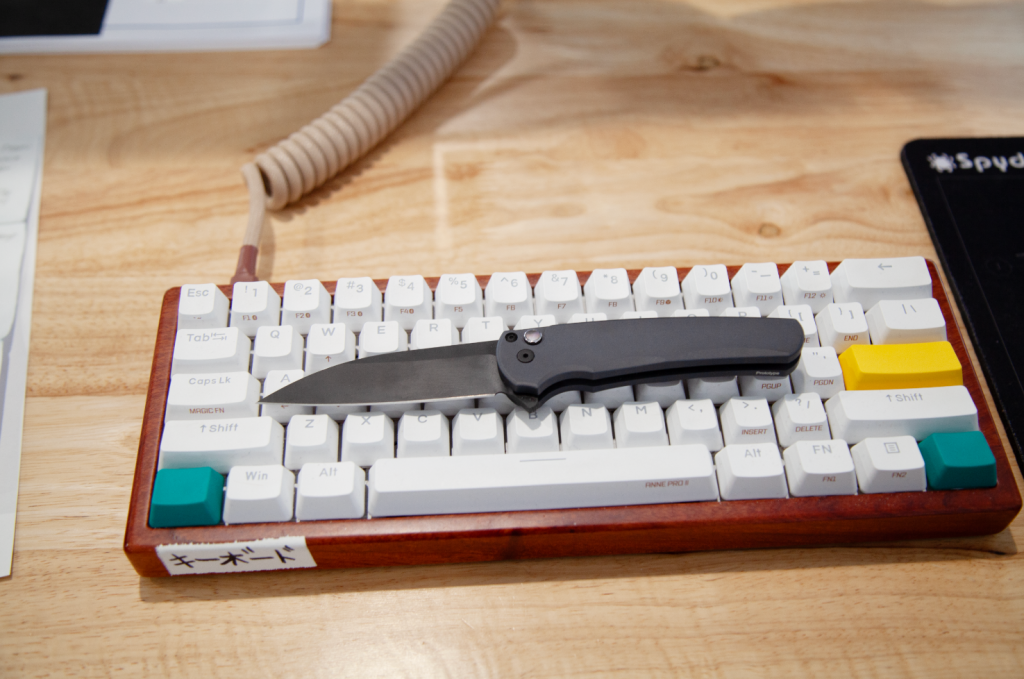
I apologize in advance, this one is a bit of a rabbit hole.
The knife community does not often describe coatings with the term "vapor deposition."
Rather, it’s a parent term we’ll use here to describe the following coatings that most knife people have heard of:
- Titanium Nitride (TiN)
- PVD
- DLC
Each of these has differences in the material of coating and how that became a vapor (I’ll explain, I promise), but they are all applied in a vacuum chamber.
Once the blade is in the vacuum chamber, an evaporated material is introduced into the vacuum and allowed to collect on the part.
This method of coating is high-tech and must be done in a facility with the proper equipment.
These coatings were designed for end-mills, drill bits, and machining parts because they drastically improve the wear resistance of the tool.
The different variations of vapor-deposited coatings have different properties useful for different applications, but most of them have found a welcome home on knives.
I’ll break down those variations below.
Titanium Nitride (TiN)
Titanium Nitride is often found on the less expensive end of knives and is the cheapest way commonly used to coat knives with vapor deposition.
It’s a type of CVD or Chemical Vapor Deposition coating.
Oversimplified, some chemicals with titanium are mixed inside the vacuum chamber, along with nitrogen gas.
The chemicals react and release evaporated titanium (don’t breathe that in), which bonds with the nitrogen, creating—you guessed it—titanium nitride.
This creates ionic bonds with the blade, and the coating is born. It’s naturally gold, but it can be changed to different colors depending on the chemicals used.
This coating is relatively thick compared to other vapor-deposited coatings and offers a great thermal barrier (not that your knife is likely to need one).
PVD
PVD is much the same process, but instead of using chemicals to evaporate the metal, an electric arc does it (don’t breathe that in either).
This yields a purer coating that adopts the color of the evaporated metal, with a lustrous metallic finish.
It’s much thinner, only a few microns thick, but has incredible wear resistance.
In addition to machining hardware, it’s popular on watches because it doesn’t scratch as easily as raw metal.
(Fun fact: the metal most often used in PVD coating is Titanium, which means it’s technically also a Titanium Nitride coating. But it’s fancier and more expensive, so most people just call it PVD.)
DLC
The last type is DLC, which stands for Diamond-Like Carbon.
Through some engineering magic I could not even begin to understand, pure carbon is introduced into the vacuum (you know the drill, don’t breathe that in) and allowed to collect on the blade’s surface in a dense crystal structure.
The resulting finish is harder than almost anything, only a few microns thick, and has the same coefficient of friction as the Teflon on a non-stick pan.
It’s so thin and low-drag that it finds its way onto firearms, watches, and other mechanisms that can’t afford to have parts bind up.
Hey, you know what else is a dense, pure-carbon crystal?
Diamond!
DLC coating is not quite as hard or scratch-resistant as diamond, and it’s not clear, but it is really hard and almost as scratch-resistant as diamond.
It’s made of carbon and is kind of like diamond, so it was named Diamon-Like Carbon (DLC). I love it when a good name comes together.
Yes, DLC also stands for Downloadable Content, but we never play video games here at Blade HQ.
Never.
Each of these vapor deposition coatings was designed for much harder work than any knife has ever endured, so they’re great if your knife needs real protection.
That durability, combined with their smooth, low-drag surface, makes them popular choices for folders with carbon steel blades.
One warning, however: Because these coatings are so thin, sometimes blades can rust through them.
That said, if you keep your knife clean and dry and you’re not cutting car batteries in the ocean, you should be fine. (Don’t cut car batteries ever!)
Pros:
- Incredible wear resistance
- Pretty, metallic look
- Very smooth
- Very thin
- Food-safe
- Resistant to heat
Cons:
- Expensive, dangerous process
- Cannot be done at home
- So thin it sometimes lets steel beneath rust
- Sometimes reflective
Does it wear?
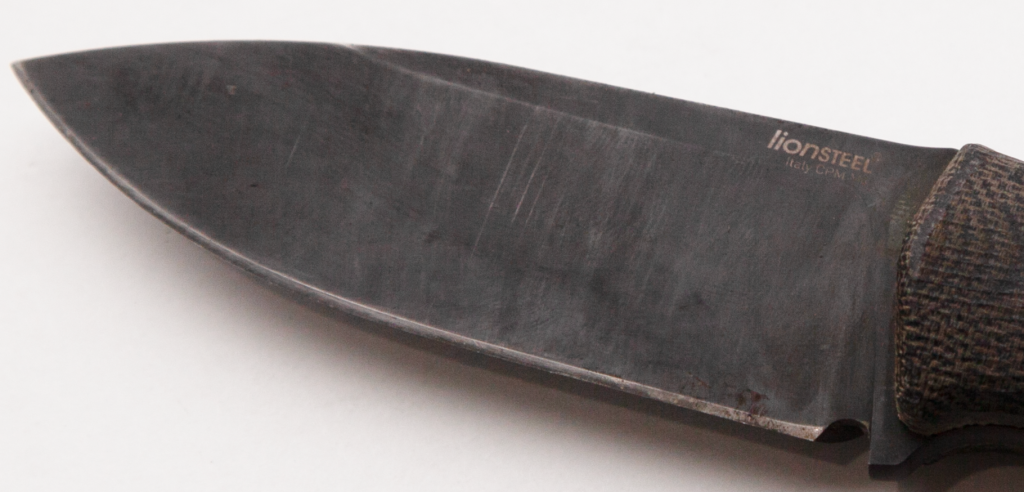
Yes, but much slower than the other coatings listed here.
I’ve beaten the living tar out of my LionSteel M4, which has a vapor deposition coating, and it has taken on a few scratches (mostly from ferro rods) and maybe a tiny bit of wear on the peaks of the grinds
But that’s it.
That said, Bushcraft Kelso, whose knives are featured in this article under Powder and Ceramic coatings, told me that he has "yet to find a coating that will last with fairly heavy use."
Interpret that how you will.
4. Ceramic Coatings (Cerakote)
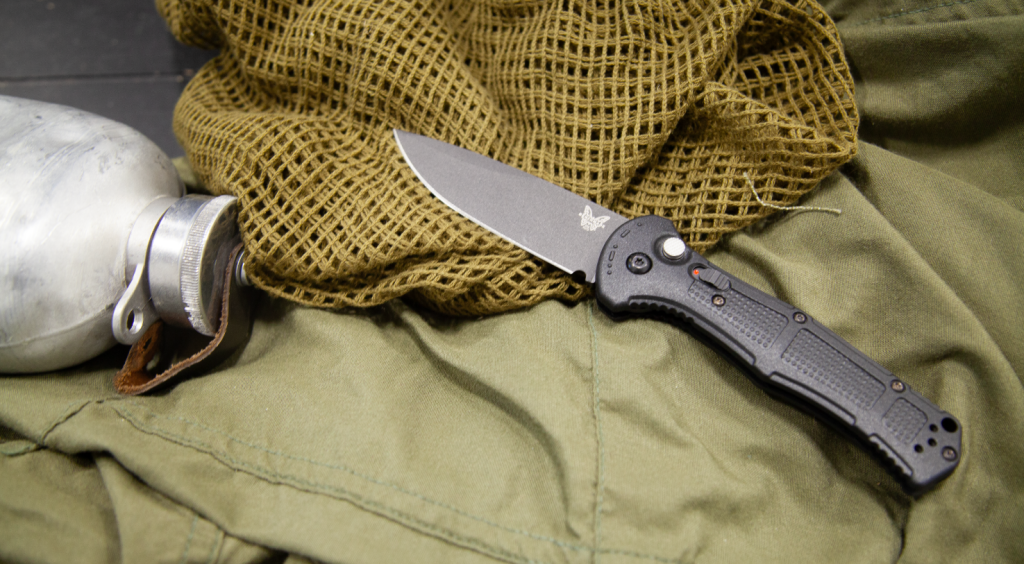
I deliberately left this at the end to make the gun nuts squirm (a lot of firearms use this coating).
There are a few different brands that have patented formulas to create optimized coatings in this class, but by far the biggest name in the field is Cerakote, and it finds its way onto everything.
To make a long story short, these coatings are applied as a powder coat of epoxy, pigments, ceramic powders, etc., and then baked on.
Think of them kind of like super-charged powder coats.
And when I say super-charged, I mean it.
This type of coating has a lot going for it: You get all the color options of paint, the ease of application of powder coat, and nearly the wear resistance of vapor deposition.
They’re thick enough to prevent water or air from ever contacting the blade’s surface, they resist scratching very well, and they are applied as solids, patterns, camouflage, etc.
Best of all, with the right setup, you can apply one at home.
The biggest applications for these coatings are custom automobiles and firearms. People who build cars and guns love that they can make a unique color code without too much trouble.
People who love knives love these coatings for the same reason!
Pros:
- Stylish
- Durable
- Protective
- Easy to apply
- Can be applied in any color or pattern
- Smooth
- Non-reflective
Cons:
- Dubious food safety
- A bit pricey
- Too thick of application can inhibit folding mechanisms
Does it wear?
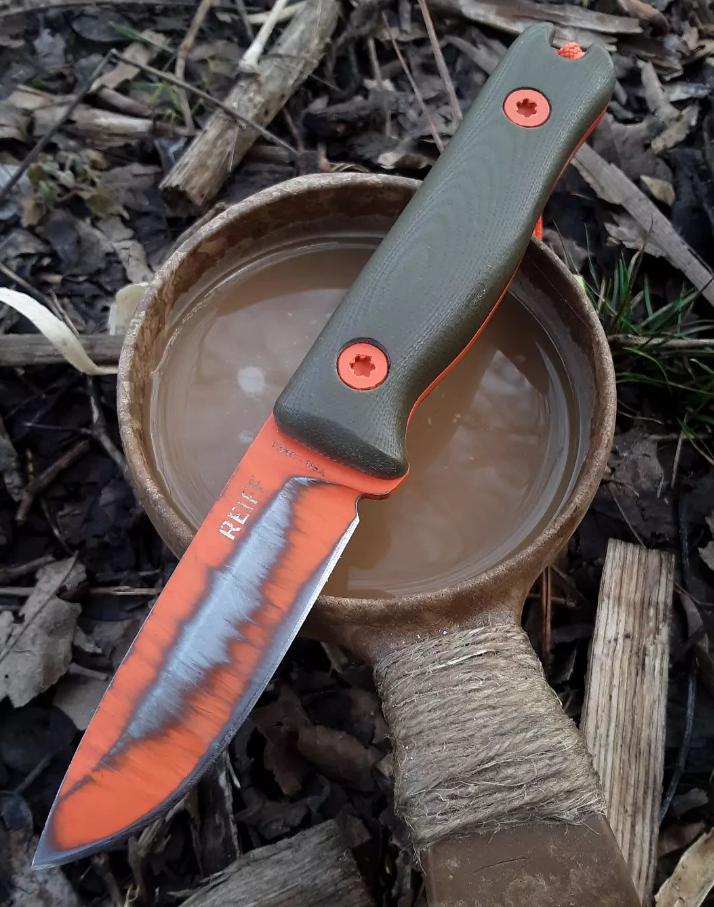
Yes, but slower than paint and powder coats.
Remember Bushcraft Kelso’s ESEE with a powder coat from earlier? Well, here’s his Reiff F3XC from December 2022.
It faded, but not as quickly or thoroughly as paint or powder coat. The fade was a bit more patchy, too.
Compare Blade Coatings
| Blade Coating | Scratch Resistance | Friction | Colors | Does it wear? |
| Paint | Low | Medium | Any | Very High |
| Powder Coat | Medium | High | Any | High |
| TiN | Medium | Low | Gold/Gray/Blue | Low |
| PVD | High | Low | Many* | Low |
| DLC | Very High | Very Low | Black | Very Low |
| Cerakote | Medium | Medium | Any | Medium |
Do You Need a Blade Coating?
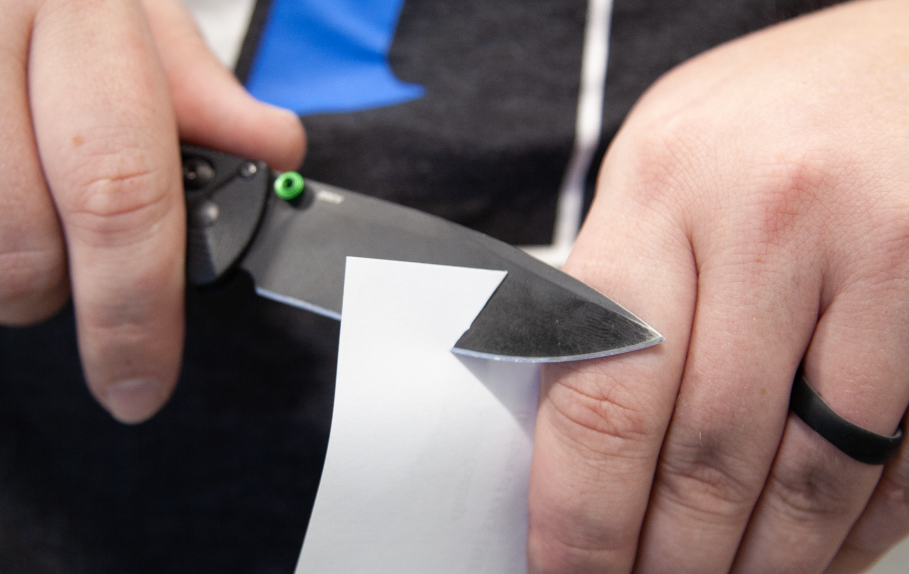
I’m glad we have access to coatings. I don’t think every knife needs one, but I do think that knives with non-stainless steels could benefit from them.
For stainless steel knives, I only take them if I think they look nice. I generally trust my stainless steels to prevent their own corrosion.
And while it’s not the most popular opinion, I do love the look of a clean, unworn black coating.
That’s why DLC coatings are my favorite: they wear very slowly.
But if you’re the kind of person who likes to see their knife beat up, then a powder coat or a ceramic coat might be the ticket!
Either way, now you know what makes each of these coatings what they are and how to pick the best one for your next knife!
FAQ
What is the best knife blade coating?
DLC is generally the best all-around blade coating. It’s exceptionally hard, highly wear-resistant, low-friction, and offers excellent corrosion resistance. But the "best" coating ultimately depends on how you use your knife.
Is DLC better than Cerakote?
Generally, yes. DLC is harder, more scratch-resistant, and wears more slowly. Cerakote offers excellent corrosion resistance and virtually unlimited color options, making it a great choice if appearance is a priority.
Do blade coatings prevent rust?
They help, but they don’t make a knife rust-proof. Most blade coatings protect the blade’s surface, but the cutting edge is typically left uncoated and still requires proper care.
Which blade coating is the most durable?
DLC is widely considered the most durable coating found on production knives. TiN and many PVD coatings are also highly durable, while paint and powder coat wear much more quickly.
Do blade coatings affect cutting performance?
Sometimes. Low-friction coatings like DLC can reduce drag through certain materials, but edge geometry and sharpness have a much greater impact on cutting performance.
Should I buy a coated or uncoated knife?
Choose a coated blade if you want better corrosion resistance or reduced glare. If you prefer the look of bare steel or don’t mind a little extra maintenance, an uncoated blade is a great option.
Which blade coating lasts the longest?
DLC generally lasts the longest thanks to its exceptional hardness and wear resistance. High-quality PVD and TiN coatings also provide excellent long-term durability.
Can a blade coating be repaired?
Some can. Paint and Cerakote can usually be reapplied. Hard coatings like DLC and TiN require specialized equipment and are much more difficult to refinish.
Which blade coatings are food safe?
Most blade coatings are not food safe. Some exceptions include Titanium Nitride coatings (e.g., TiN and PVD) and DLC.


 Copyright © 2026 Blade HQ. All rights reserved