



The Ultimate OTF Knife Guide: Legality, Styles, How They Work, and More



OTF (Out The Front) knives are complex and exciting, and there’s a lot to know about them.
This article is for anyone interested in OTFs, whether you’re a collector, EDC enthusiast, tactical expert, or just a beginner.
Below is a list of topics we cover in this article. You can jump between topics to answer your specific questions or keep reading for the whole download.
Table of Contents
What Is an OTF Knife?
OTF stands for "Out The Front."
OTF knives are called that because their blades fire out the front (top) of the handle, rather than swinging out the side like folding knives.
When people are talking about OTF knives, they’re usually talking about double-action OTFs, which have a switch that you can use to automatically deploy and retract the blade.
That’s what double-action means: you can both open and close the knife automatically.
But some OTFs are single-action, fully manual, or use other mechanisms. This article is mostly about double-action OTFs (the most common), but we’ll touch on a bit of everything.
The History of OTF Knives

While the details aren’t totally clear, we know that the modern OTF evolved from early sliding-blade knives.
Germany’s 1930s Flieger-Kappmesser (pictured above) was one such blade. It established the practical one-handed OTF format, although it relied on gravity/inertia rather than a spring.
Automatic OTFs appeared commercially during the mid-20th century, but the federal Switchblade Act of 1985 limited their availability in the USA.
Despite that, in the 1990s, tactical knives exploded in popularity. Come 1995, laws began to loosen, and Microtech released its first OTF knife: the Halo.
While the Halo was a single-action design, in 1999, Microtech introduced the world to the Ultratech—which is easily the most popular OTF model of all time.
Today, better manufacturing and relaxed state laws have transformed OTFs from a niche tactical design into a major pocket-knife category.
Though Microtech paved the way, these days, many companies produce high-end OTFs (which we’ll look into more later).
Types of OTF Knives
When you think of an OTF knife, you’re likely thinking about something like the Microtech Ultratech.
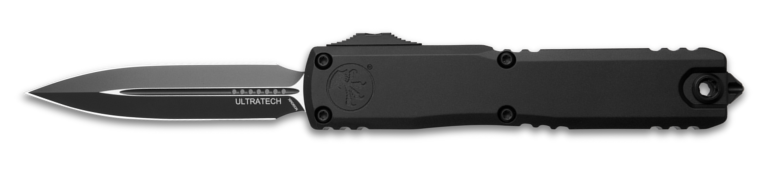
Your typical OTF is double-action, automatic, and has a dagger-style blade.
But the OTF landscape is a diverse one, and there are many common blade shapes beyond the standard double-edged dagger.
Below, we’ll explore each OTF mechanism, common blade shapes, and typical size categories.
OTF Knife Mechanisms
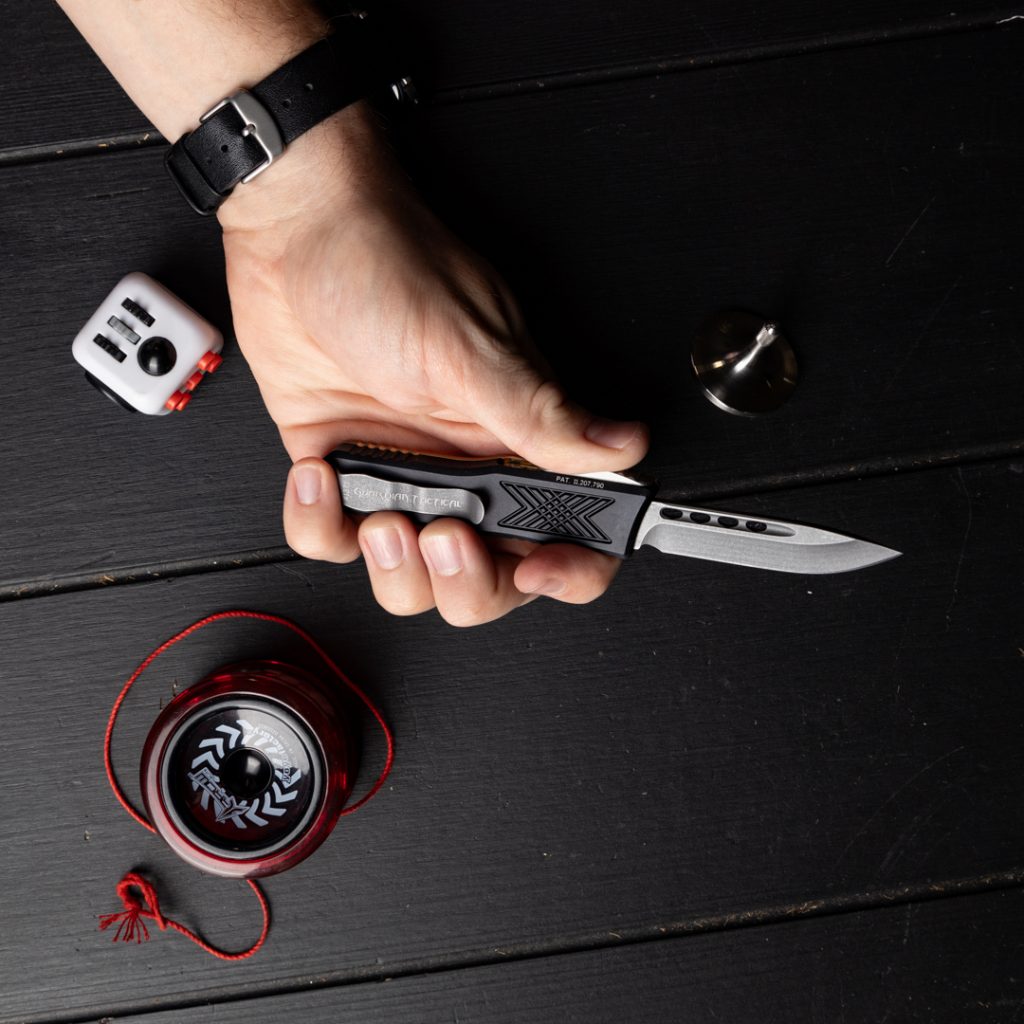
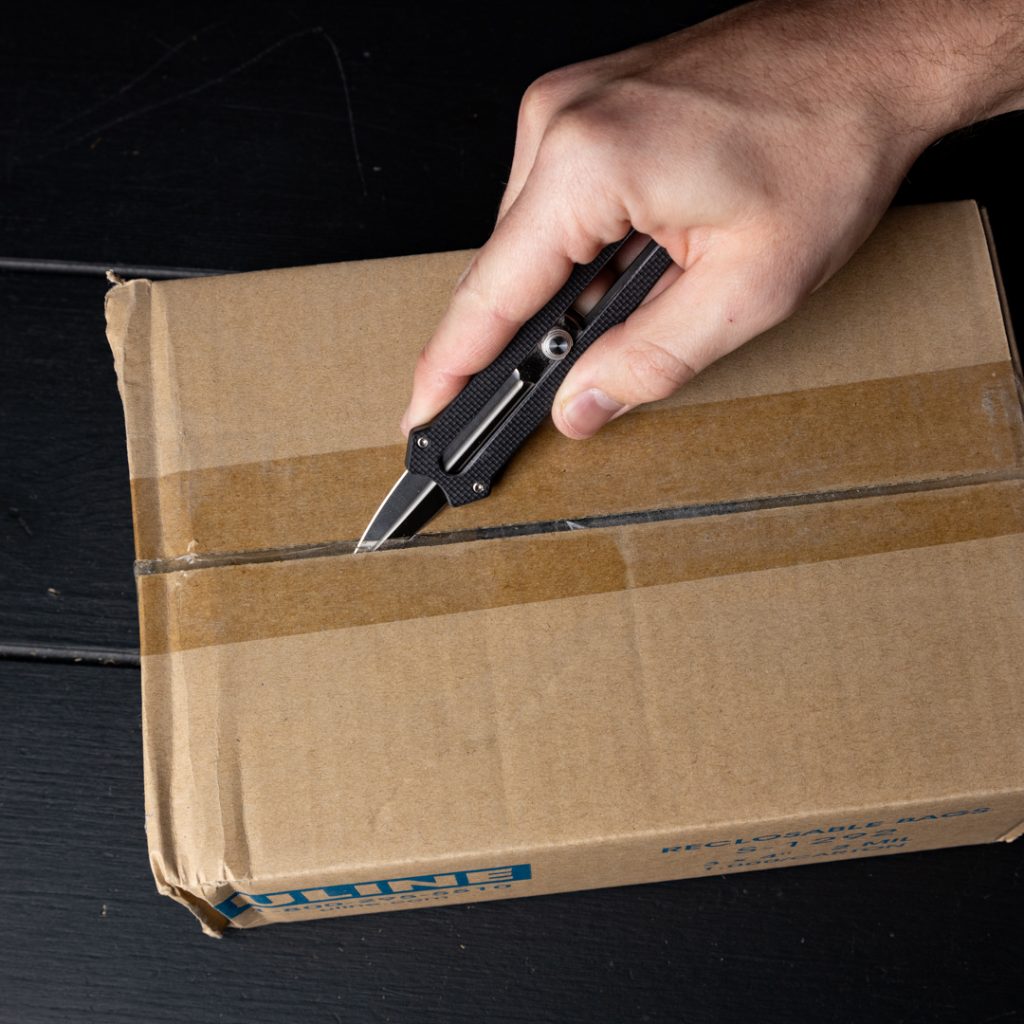
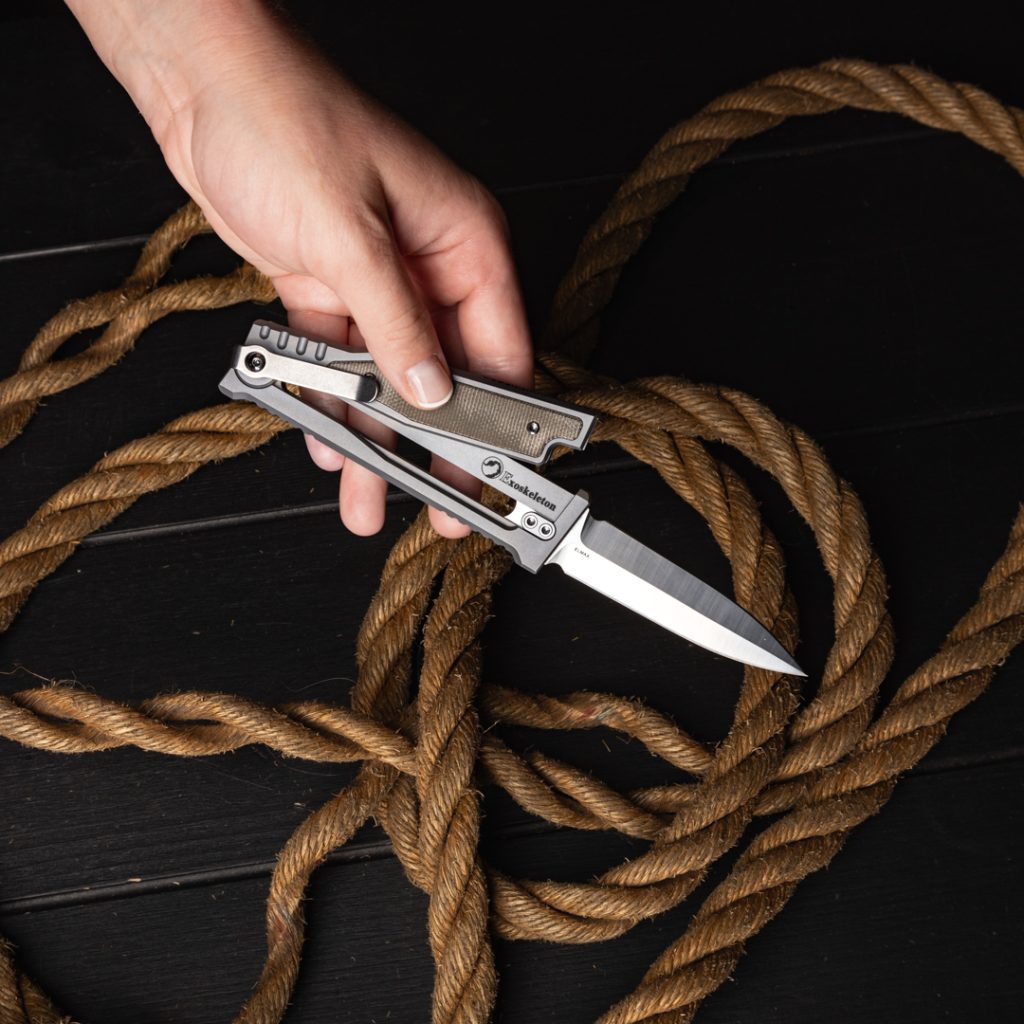
Double-Action OTFs (Automatic)
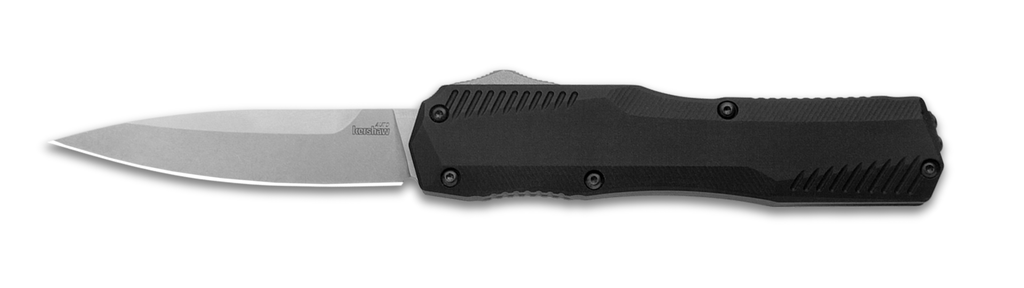
This is the most common type of OTF, and it’s arguably the most awesome.
On these knives, the blade both extends and retracts automatically when you slide the switch. The first time you do it, it feels like magic.
But it’s not magic; it’s engineering. Skip ahead to learn how the mechanism works.
Single-Action OTFs (Automatic)
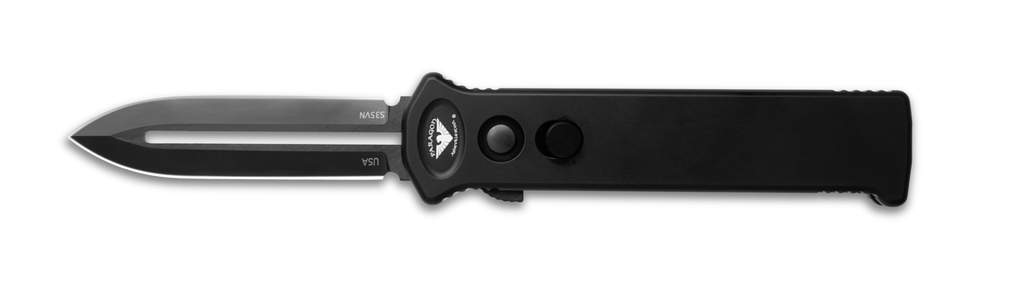
Single-action OTFs only open automatically.
Like a typical side-opening automatic knife, all you have to do is push a button and bam! The blade’s out.
Closing this type of knife is more involved, requiring you to manually drag the blade back into the handle via a charging handle (as seen on the Heretic Hydra) or a simple tab (like on the Paragon Para-X).
Gravity OTFs
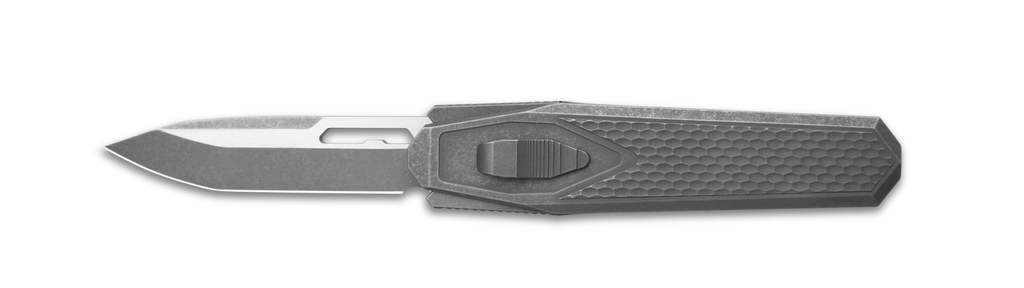
Gravity OTF knives don’t use a spring; they use gravity (bet you didn’t see that one coming).
Simply disengage any lock keeping the blade closed, turn it upside down, and voilà!
Reate (with the EXO series) and REMETTE (with the Swordfish) are the leading manufacturers in this category.
Spring-Assisted OTFs
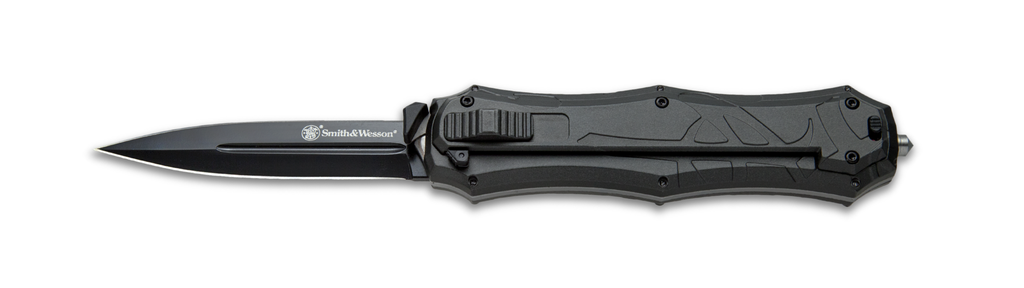
Like single-action OTFs, but legally distinct.
On these knives, you sort of nudge the blade into action, and a spring takes it the rest of the way.
Then it’s up to you to drag the blade back closed.
Smith & Wesson (M&P) makes some fantastic, budget-friendly spring-assisted OTF knives.
Manual OTFs
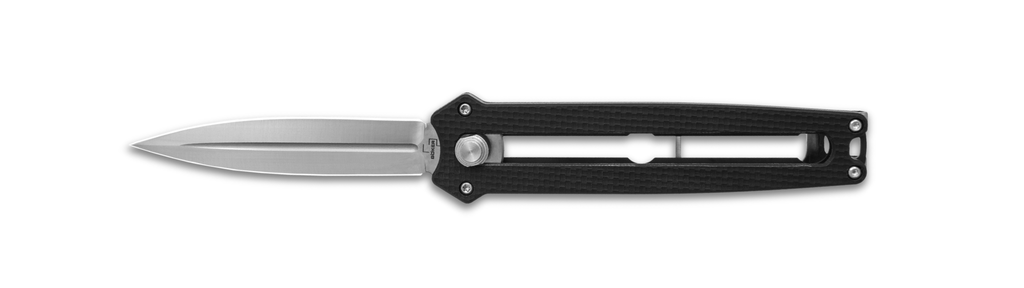
For these OTFs, it’s all you: You open it, you close it.
And it’s that simple.
The Boker Slike is an example of this type of pocket knife done well.
OTF Knife Blade Shapes
You can find just about any blade shape on an OTF knife, but some are more common than others.
We have two main categories to look at: double-edged and single-edged.
Double-Edged
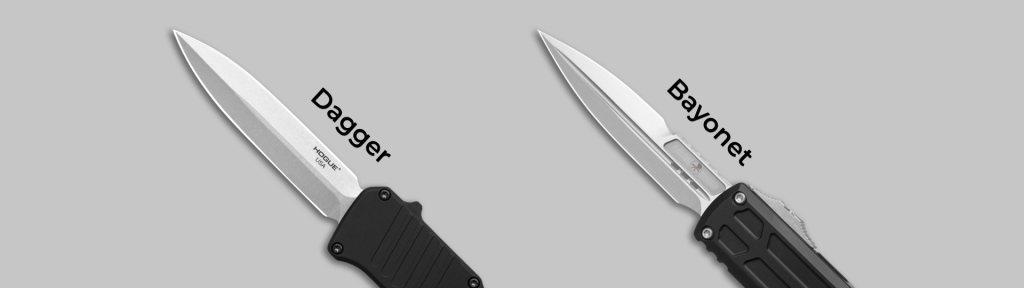
When it comes to pocket knives, you likely won’t see a double-edged blade except on OTFs.
The reason is that OTFs fully house the blade in the handle, keeping both edges safely covered.
The two double-edged blades you’ll find on OTF knives are dagger and bayonet.
Neither of those is exclusively double-edged, but on OTFs, they usually are.
A dagger blade has two full edges, while the back edge of a bayonet blade has an unsharpened section at the base of the spine.
Pros:
- Can cut on either side
- Better at piercing
- Looks awesome
Cons:
- Disallows you from placing your thumb on the blade spine (dagger blades only)
- Short, steep bevel reduces slicing efficiency
Single-Edge
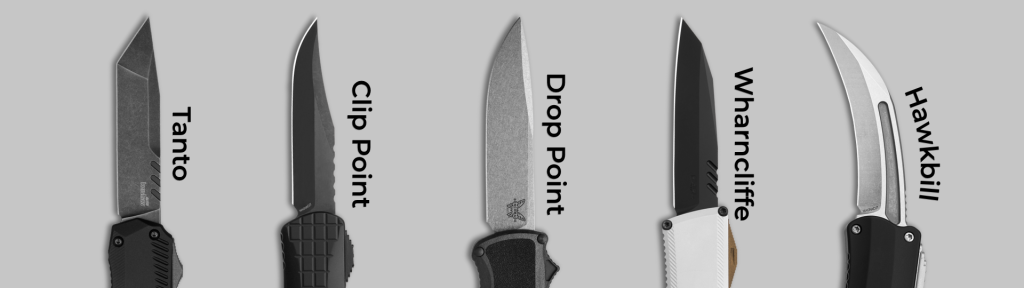
Single-edge blades appear in many forms on OTF knives.
Each has its own micro advantages/drawbacks. (Check out our Knife Blade Shapes Guide to learn more.)
Here’s a list of some of the most common single-edged blade styles for OTFs:
Pros:
- Easier and faster to sharpen
- You can rest your thumb on the blade spine for improved control
- Many styles to choose from
Cons:
- Only has one cutting edge
- Less effective at piercing
OTF Knife Sizes
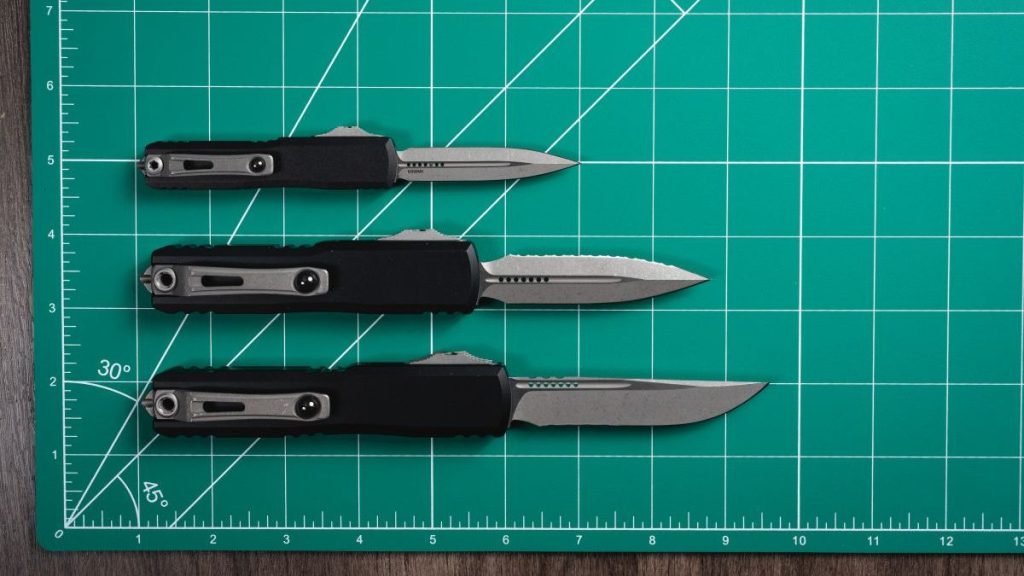
There are three general sizes of OTF knives: large, medium, and small.
- Small – These OTFs are super pocket-friendly, easier to use, and a little cheaper. Choose a small OTF for an optimal EDC experience.
- Medium– These OTFs are "just right," to quote Goldilocks. They’re big enough to be tactical, small enough for daily carry, and available in endless variety.
- Large – These OTFs are big, loud, and mean business. Sure, you can open a box with one, but more likely you’re taking it to war or on patrol. They’re intimidating, pricey, and punchy.
Okay, okay, you don’t need to be going to war to get a large OTF. Many collectors and EDC users prefer larger knives. And maybe you want to take a small OTF to war!
The point is, get the size that excites you, and use it (responsibly) however you want.
How Does an OTF Knife Work?
Different types of OTFs work differently (big shocker).
But while single-action, gravity, and manual OTFs are all rather straightforward in their functionality, double-action OTFs can be confounding!
Time to dispel the mystery. This is how double-action OTF knives work:
Parts & Terminology
In order to explain how double-action OTFs work, we need to be on the same page about what we’re calling the various components.
There’s no universal name for most of these parts, so we’ve gone ahead and labeled them in ways we hope are intuitive.
[Image coming soon: Parts of an OTF (labeled)]
- Switch (Thumb Slide/Button) – A switch that’s connected directly to the Slider. Moving it up and down fires/retracts the blade.
- Slider – An internal sliding plate within the knife, sandwiched between the Chassis and the Handle Cover. It interfaces with the Lock Gates, Spring Assembly, and Switch to facilitate the knife’s functionality.
- Chassis (Handle) – The larger side of the handle. It has a milled-out slot in which the blade slides, as well as two smaller slots for the Lock Gates.
- Handle Cover – More or less a lid for the knife. It completes the handle and holds everything together.
- Gate Locks – Two spring-loaded "gates" inset at the top and bottom of the Chassis. These interface with the Blade, locking it closed and open.
- Spring Assembly – Two metal brackets connected by a spring. It rests over the Slider and interfaces with the Blade and the Catch Pin.
- Catch Pin – A pin inside the Blade tang. The top bracket of the Spring Assembly catches this pin to drag the Blade back into the handle. The Catch Pin also often functions as a stop pin, preventing the blade from leaving the handle entirely.
- Blade – The sharp, pointy bit you cut with. Usually has a hole in the tang (the unsharpened bottom of the blade) for the Catch Pin and a "shoulder" that interfaces with the bottom Lock Gate (the top Lock Gate typically wedges under the blade tang).
How It All Functions
Let’s set the stage. Your OTF is closed. This means the Slider and Switch are down, there’s no tension in the Spring Assembly, and the Blade is locked under the bottom Gate Lock.
What happens as you slide the Switch forward to fire the blade? The Slider moves up, and two things occur simultaneously:
- As the Slider moves, it begins pushing the bottom Gate Lock open.
- The Spring Assembly is connected to the top of the Slider and the bottom of the Blade. As the Slider moves up, since the Blade is locked at the bottom, the spring begins extending, building tension.
Now you’ve finished sliding the Switch forward. Here’s what happens to cause the Blade to deploy:
- As the Slider reaches the top, it finishes pushing open the bottom Gate Lock.
- Since the spring is fully extended and there’s nothing keeping the blade from moving, the spring retracts, throwing the Blade out the front of the handle.
- The blade pushes aside the top Gate Lock as it deploys; once fully open, the top Gate Lock springs into place, wedging under the Blade tang.
Closing the knife is only a little different:
- The Slider moves aside the top Gate Lock, and the spring extends, being connected now to the Catch Pin and the bottom of the Slider.
- When the Slider opens the top Gate Lock, the Spring Assembly yanks the Blade back into the handle. It pushes aside the bottom Gate Lock, clicking back into place.
TL;DR
Too long? Didn’t read? Here’s a summary:
- Moving the Switch moves the Slider.
- As the Slider moves up, it begins extending the spring and moving aside the bottom Gate Lock.
- The Blade is locked at the bottom until the Slider (and Switch) moves all the way to the top.
- When the Slider is at the top, the bottom Lock Gate opens, and the Blade is free; the Spring Assembly throws the Blade out the front of the handle.
- When closing the knife, the top Gate Lock keeps the blade from retracting until the Slider is all the way down. The Spring Assembly, now connected to the Catch Pin in the Blade and the bottom of the Slider, yanks the Blade by its Catch Pin back into the handle.
Not All Double-Action OTFs Function Identically
This is the most common mechanism you’ll see in a double-action OTF knife, but it’s not the only one.
But whatever the specifics are for more unique mechanisms, the underlying principles are universal: build energy, release the blade, lock it in place.
OTF Knife Pros and Cons
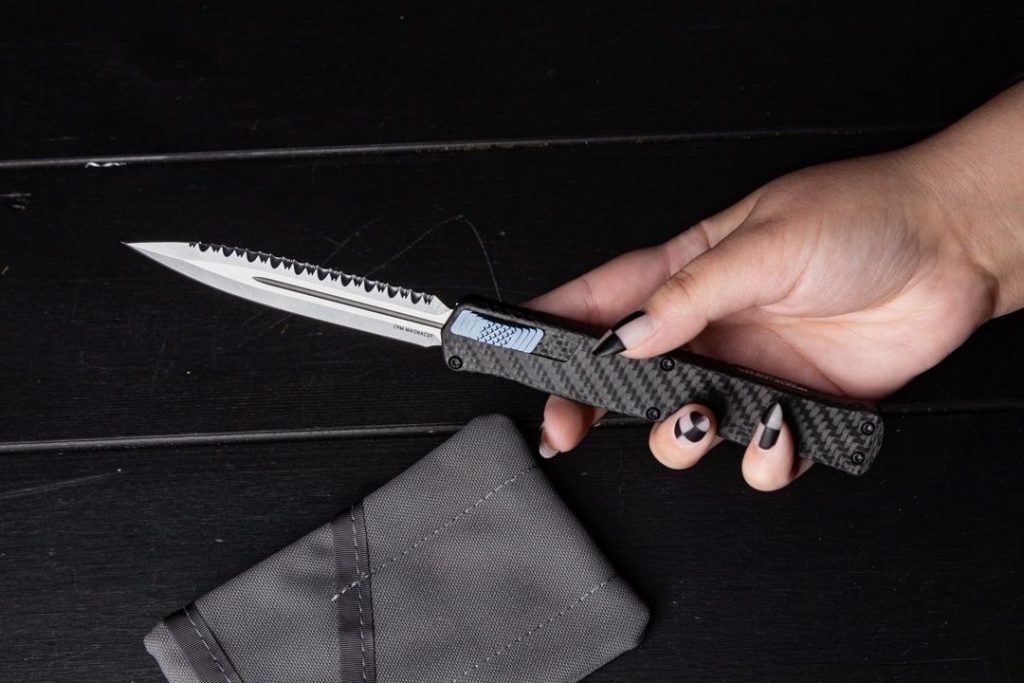
There are many good reasons to choose an OTF knife, and some good reasons not to.
Despite thier con, OTFs remain one of the most popular knife types because the pros are just that good!
Pros:
- Easy to use with one hand
- Serious "cool" and "wow" factors
- Permits a double-edged blade
- Extremely satisfying to fidget with
- Fingers out of blade path while closing
- Ambidextrous
- Great conversation starter
Cons:
- Blade can "come off track"/misfire
- Typically higher price
- Mechanically complex and tricky to maintain
- Requires a certain amount of thumb strength to operate
- Usually some blade play
- Illegal in some areas
- Lingering stigma
How to Choose an OTF Knife
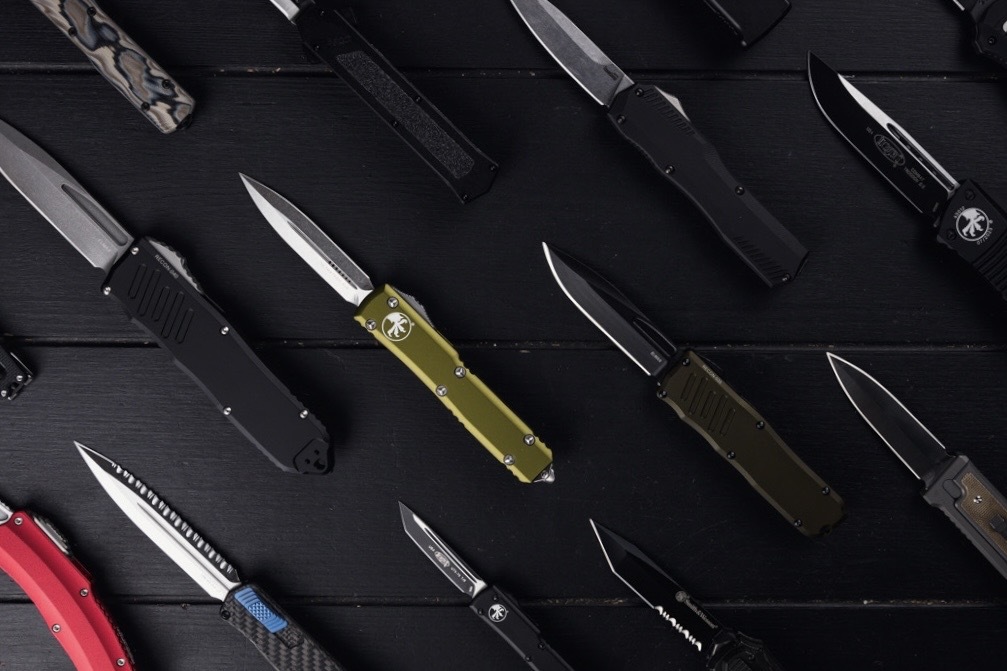
If you’re looking for the right OTF for you, consider how you plan to use the knife. Find your use case/situation below and check out the recommendations!
EDC (Everyday Carry)
You want a reliable OTF that’s fun to fidget with and not too big. Since you’ll use it a lot, you want it to be ergonomic.
Tactical/Military
We recommend an OTF that’s large, easy to use with gloves, and reliable.
Hiking/Camping
While OTF knives aren’t ideal for camping, a lightweight OTF is great for a hike (especially manual ones).
Utility
If you’re opening a lot of packages or cutting things for work, you’ll want an OTF that’s easy to use one-handed, holds an edge/has a replaceable blade, and won’t get in the way.
For more OTF recommendations, check out our article on the best OTF knives!
Novelty
OTFs are really cool, and you want to show one off. Maybe you don’t plan to use it much, but you still want it to be high quality.
Collection
You’re looking for special treatments or one-of-a-kind OTFs. The shinier, the better.
Switchblades Restricted
You live somewhere where switchblades are illegal or restricted but still want an out-the-front blade.
On a Budget
OTFs are awesome but can cost a lot. You’re on the hunt for great options that won’t break the bank.
Top OTF Knife Makers
These days, many manufacturers produce quality OTF knives. The handful we’ve listed here isn’t an exhaustive list, but it’s a great place to start.
Pick a brand that speaks to you and browse its offerings. You may find exactly what you’re looking for!
Axial
Coleby Brewer began the company in 2021. Axial focuses on producing high-quality OTF knives at a competitive price. Its offerings are 100% USA-made.
Benchmade
Benchmade is a family-owned American business that has produced premium knives for over three decades. It sells a lot more than OTF knives, but its OTFs are worth mentioning.
Guardian Tactical
Guardian Tactical builds all its knives in America, focusing on tactical OTFs known for their super-smooth action.
Hawk Knife Designs
Hawk Knife Designs (formerly G&G Hawk) is run by Gavin Hawk. He and his late father invented the Deadlock OTF, famous for its total lack of blade play. Many consider the Deadlock OTF the pinnacle of OTF knives.
Heretic Knives
Heretic makes all kinds of knives, a fair few of which are OTFs. It pushes design boundaries to bring truly unique pieces to market. All its knives are made in the USA.
Hogue
Hogue began with gun grips but expanded into premium pocket knives, including exceptional OTFs. While its selection isn’t vast, its prices are hard to beat.
Kershaw
At time of writing, Kershaw offers very few OTFs, only one of which is automatic: the Livewire. The Livewire is good enough to land Kershaw a place on this list by itself.
Microtech
Microtech is perhaps the most well-known OTF manufacturer. It all but invented the modern automatic OTF, and boasts a truly vast selection with a premium feel that’s hard to beat.
Paragon Knives
Paragon is known more for the Warlock gravity knife than anything, but it’s also one of the main makers of premium single-action OTFs, landing it a place here.
Piranha
Piranha is a small, family-owned company in Idaho, USA. Its OTFs have a distinctive look and feel that you won’t find anywhere else.
Reate
Located in Yangjiang, China, Reate is known for its exceptionally high-quality manufacturing. In 2021, it produced the EXO—an OTF gravity knife—which was an instant hit.
Smith & Wesson
Smith & Wesson bypassed tricky laws restricting switchblades with its spring-assisted OTFs. Coming in a few styles and at an extremely accessible price, you get a lot of bang for your buck.
Are OTF Knives Illegal?
No. There is no nationwide ban in the USA on owning switchblades, OTF or otherwise.
While federal law regulates automatic OTF distribution and possession in certain jurisdictions, state and local laws determine where most people may own or carry them.
In most US states, you can legally own, carry, and use OTF knives freely.
Some states like California have restrictions, though, limiting blade length to under two inches for automatic knives. (If you’re in that boat, check out the CA-legal OTFs we have for sale!)
Other states and certain cities have even heavier restrictions or outright bans. Before buying an OTF, check your local laws!
You can read more about switchblade legality in our article on the topic: Are Switchblade Knives Illegal?
How to Maintain an OTF Knife
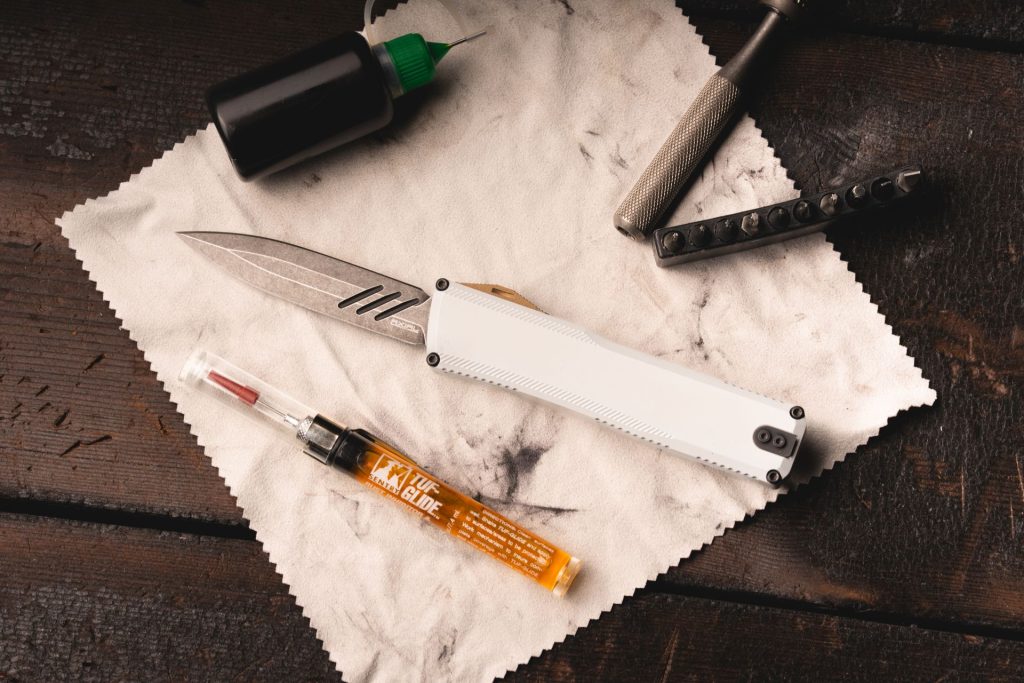
OTF knives—specifically double-action OTFs—are complicated and require unique maintenance. Double-action OTFs can also have their blade come "off track," where the blade is loose in the handle.
We’ll address the basics below. If you’re looking for a more in-depth guide, including information on disassembly, review our OTF Knife Maintenance – A Guide to OTF Care article.
What Causes an OTF to Come "Off Track"/Misfire?
Firing the blade into anything more flimsy than a plastic back will usually cause a misfire.
If there’s a buildup of lint, oil, or other scum inside your knife, it’s more likely to misfire.
A lesser-known cause of OTF misfires is deploying/retracting the blade while the knife is in motion: Inertia can sometimes create enough friction to prevent the blade from locking open/closed.
How to Fix an "Off-Track" or "Derailed" Blade
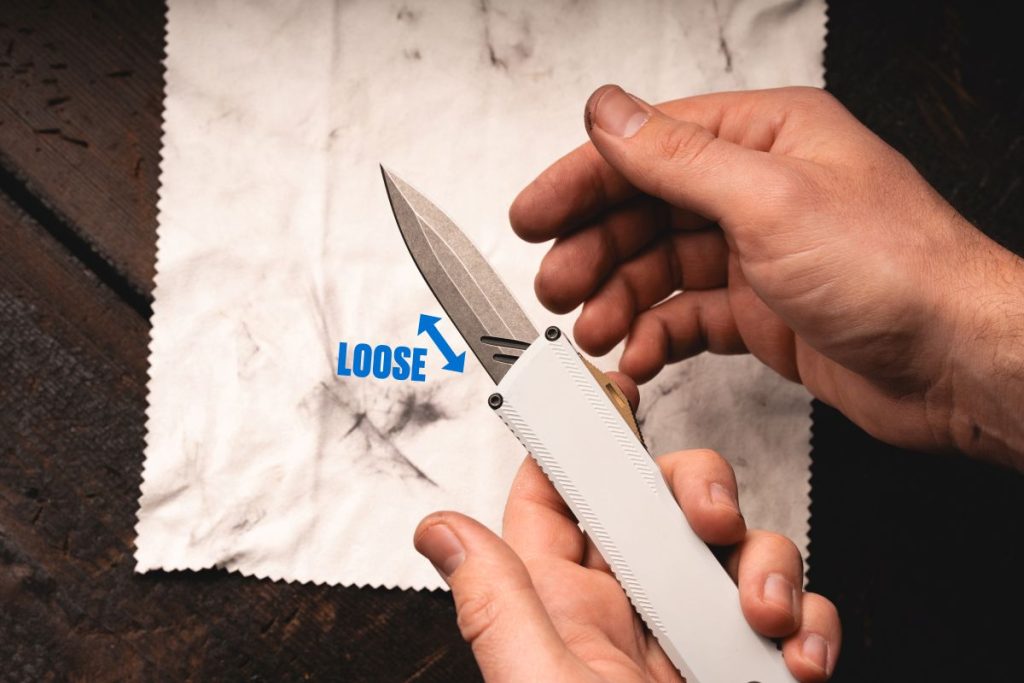
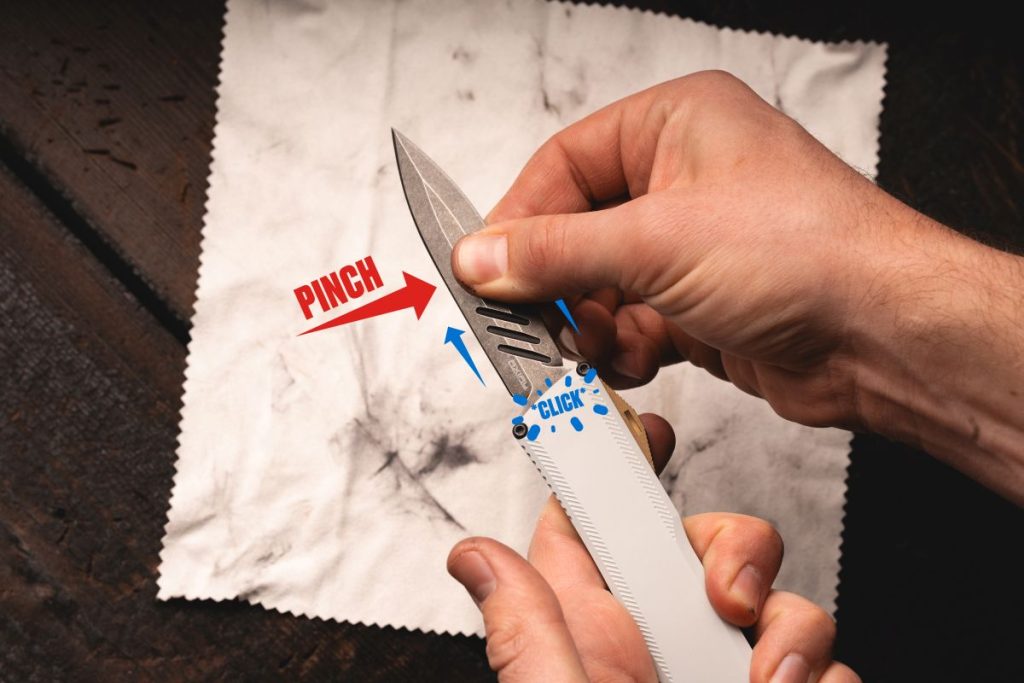
To put a blade back "on track," pinch the blade flat between your fingers and, taking care to avoid the edge(s), pull it all the way out until it clicks.
It’s that simple!
If your OTF keeps coming off track, it may be time to clean and/or lubricate it.
How to Lubricate Your OTF
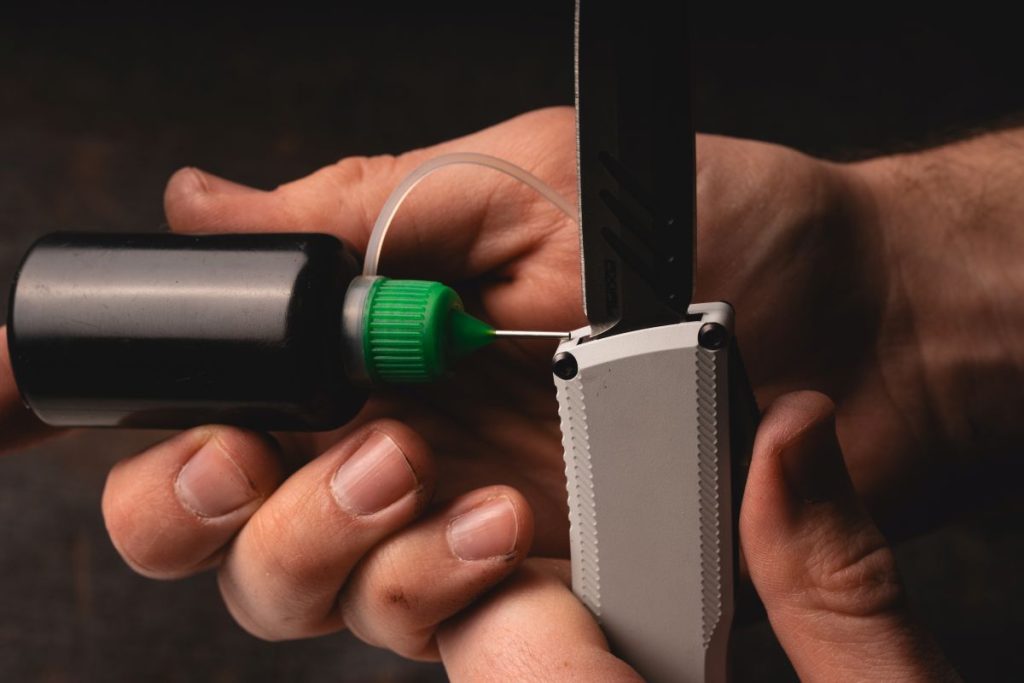
First, you need to get the right oil. Go with an OTF-specific oil (Heretic Knives makes a great one!) or a thin lube like Tuf-Glide (available in our Knife Care Kit).
Don’t use a thick oil! It will likely cause your knife to misfire more frequently, not less.
When it comes to lubricating your OTF, less is usually more.
Simply apply a drop at either end of the blade where it contacts the handle, fire and retract the blade a few times, and you’re all set!
How to Clean Your OTF
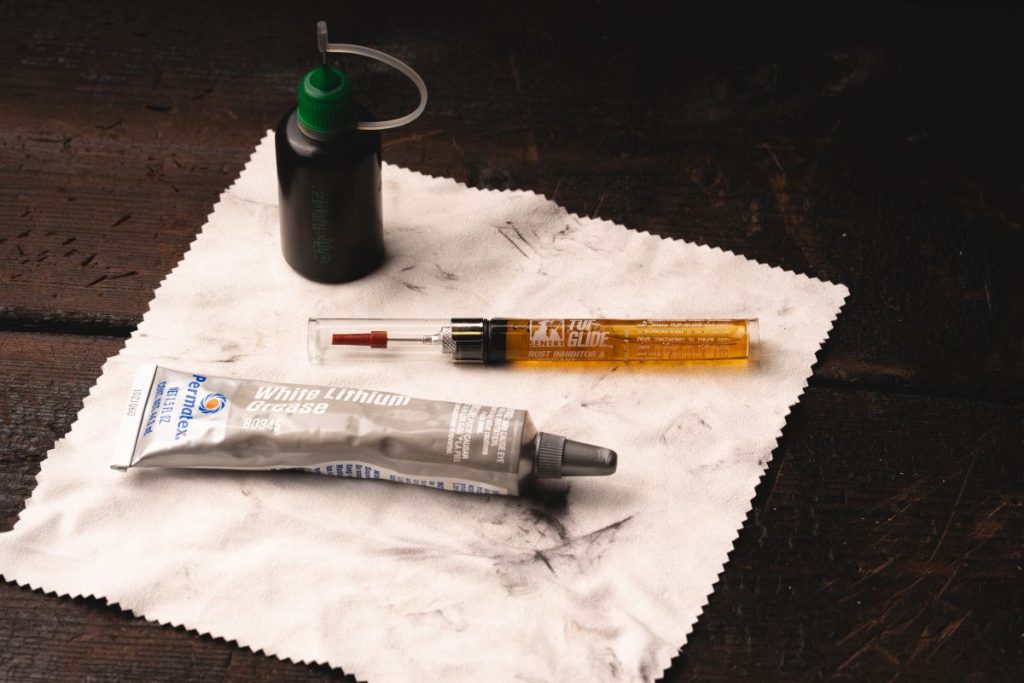
If your OTF consistently misfires, it could be due to an accumulation of lint, dirt, or other scum inside the handle.
The easiest things to try are:
- Blow into the handle.
- Use a Can of Air (or other compressed air) to blow into the handle.
If neither work, your OTF may require disassembly to fix. Check out our OTF Knife Maintenance – A Guide to OTF Care article for a walkthrough.
Here are some things you shouldn’t do when cleaning your OTF:
- Put water in the handle. This will cause misfires and could cause rust.
- Dump lots of lubricant into your knife. OTFs work best with just a touch of oil.
- Disassemble your knife without knowing what you’re doing. There are small parts that are easy to lose, and you could void your warranty.
OTF Knife Safety Tips
Here are five tips for safely using your OTF knife. This list is not exhaustive, but it covers the basics:
- Don’t fire the blade into anything you’re not willing to cut.
- Grip the knife firmly when firing the blade to prevent it from leaping from your hand.
- Refrain from fidgeting with your OTF in crowds or around children where you can’t predict where people will be.
- Instruct anyone borrowing your OTF how to use it before you give it to them.
- Practice basic knife safety: cut away from yourself, stay an arm’s length from others while using your knife, etc.
Frequently Asked Questions
Are OTF knives legal?
In most US states, yes. But OTF knife laws vary by state and locality. Always check current local laws before buying or carrying one
Is an OTF knife considered a switchblade?
Automatic OTFs are switchblades because the blade deploys automatically using a switch or button. However, manual and assisted-opening OTF knives don’t qualify.
What’s the difference between single-action and double-action OTF knives?
Single-action OTFs deploy automatically but must be retracted manually. A double-action OTF uses the same switch to deploy and retract the blade automatically.
Why do OTF knives have blade play?
Double-action OTF blades require some clearance to travel through the handle, so a small amount of movement is normal. Excessive movement may indicate wear, damage, or a poorly constructed mechanism. Some luxury OTFs, like those created by Hawk Knife Designs, have no blade play at all!
Are OTF knives reliable?
A well-made, properly maintained OTF can be highly reliable. Dirt, pocket lint, thick lubricant, and sticky cutting residue can interfere with consistent operation.
What should you do if an OTF knife misfires?
Carefully pull the blade by its flats into its fully extended position; once it clicks, cycle the action a few times. If misfires continue, clean the knife according to the manufacturer’s instructions, send it in for service, or try servicing it yourself.
How often should you clean an OTF knife?
Clean your OTF whenever the action becomes slow, gritty, or unreliable. Compressed air can remove pocket lint, while a small amount of light lubricant can restore smooth operation. Avoid over-lubricating and thick oils.
Are OTF knives good for everyday carry?
Yes. OTF knives offer fast one-handed operation, compact storage, and convenient automatic blade closeing. They’re excellent EDC tools for many users, although they typically cost more and require more maintenance than manual folders.
Can you deploy and OTF accidentally?
Yes, but it’s uncommon. Double-action OTFs are particularly difficult to open unintentionally, and even if opened directly into your flesh, the cut would probably be minor, as the blade would misfire before doing much damage. Other automatic OTFs typically feature a safety mechanism or recessed buttons to prevent unintentional blade deployment.
Are OTFs suitable for self-defense?
Yes, with a caveat: Since double-action OTFs can misfire, the blade could be left loose in the handle in a moment of crisis. Even a perfectly maintained and functional OTF can sometimes misfire. For that reason, fixed blade knives and conventional out-the-side automatics are preferred by some users.
Does a little blade play indicate a bad OTF?
Most OTF knives have a bit of built-in blade play—the blade needs to be as low-friction as possible for dependable operation. For that reason, a little blade movement is no cause for alarm. Excessive blade play, however, may indicate a poorer-quality OTF knife.


 Copyright © 2026 Blade HQ. All rights reserved